
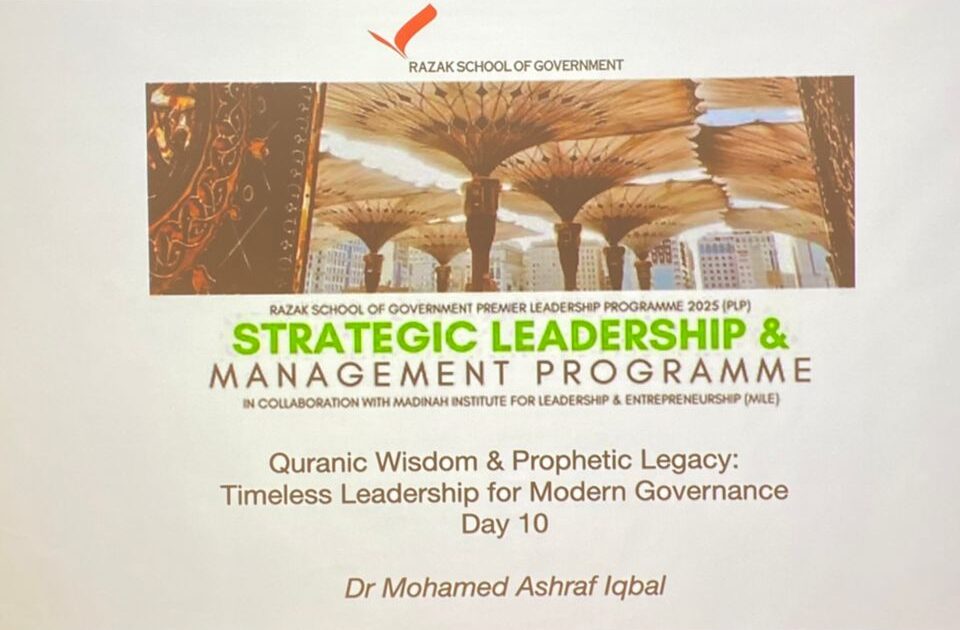

Participants of the Razak School of Government Premier Leadership Programme 2025
At MindSpring Group, we believe that the most enduring leadership principles are those rooted in timeless wisdom.
On 6th October 2025, in the Holy city of Medina, we had the privilege of hosting a special workshop titled “Quranic Wisdom & Prophetic Legacy: Timeless Leadership for Modern Governance.”
Designed for public servants and organizational leaders, the session provided a deep, reflective space to explore how Islamic teachings and prophetic examples can inform and elevate contemporary leadership practice.
Why This Workshop?
In an era of rapid change, ethical ambiguity, and growing public scrutiny, leaders are seeking frameworks that are not only effective but also principled and sustainable. The workshop was built on the conviction that the leadership model of the Prophet Muhammad (SAW) and the foundational era of Islam offer profound insights into:
- Building trust in divided societies
- Governing with justice and accountability
- Leading with both courage and compassion
- Transforming daily work into meaningful service
Lead with wisdom. Govern with justice. Serve with excellence.
What We Explored: A Journey from History to Application
The session was structured as an interactive journey through history, spirituality, and practical ethics.
1. Historical Foundations: Leadership that Transformed a Civilization
We began by examining the remarkable historical arc from 610 to 661 CE – a period that saw the birth of a faith and its rapid development into a civilization influencing much of the known world. Participants reflected on the core leadership strategies employed by the Prophet Muhammad (SAW) and the Rightly Guided Caliphs to unify tribes, administer justly, and scale governance across diverse cultures. This wasn’t merely a history lesson; it was a case study in visionary, principled expansion.
2. The Spiritual Compass: Islam, Iman, Ihsan
A key segment differentiated the dimensions of Islam (submission), Iman (faith), and Ihsan (excellence). We discussed how true leadership begins with inner integrity (Iman) and culminates in Ihsan – the excellence that comes from acting as if you see God, knowing He sees you. This spiritual framework redefines accountability, moving it beyond performance metrics to a deeper, conscience-driven commitment.
3. The “Beautiful Couplet”: A Two-Line Leadership Code
One of the most impactful takeaways was the introduction of the Quranic “Beautiful Couplet”:
- Quran 17:36: “Do not follow what you have no knowledge of…” (The imperative for evidence-based, thoughtful leadership)
- Quran 61:2: “O believers! Why do you say what you do not do?” (The call for integrity and alignment between word and deed)
Together, these verses form a powerful ethical loop: Seek Truth → Speak Truth → Act Truthfully.
4. From Work to Worship: The Five Conditions
We explored Dr. Yusuf Al-Qaradawi’s framework for transforming mundane work into worship by ensuring it is lawful, well-intentioned, performed with excellence, within ethical boundaries, and does not distract from higher duties. This resonated deeply with professionals seeking to infuse their daily roles with greater purpose.
5. The Cardinal Virtues & Vices: An Islamic Leadership Matrix
Participants engaged with a classical virtue ethics model adapted for leadership:
- Virtues to Cultivate: Wisdom (Al-Hikmah), Justice (Al-‘Adl), Courage (Ash-Shajā‘ah), Temperance (Al-‘Iffah)
- Vices to Avoid: Slander, Envy, Greed, and Betrayal of Trust
This framework provided a clear mirror for self-assessment and growth.
6. Modern Governance & The Islamicity Index
We introduced the Islamicity Index – a global study measuring how closely countries adhere to Islamic principles in economics, governance, human rights, and international relations. The data sparked rich dialogue on the gap between ideal and practice, and how Muslim-majority nations can bridge it through institutional reform.
Participant Reflections & Key Takeaways
Throughout the workshop, leaders reflected on their own challenges from managing team conflict to upholding transparency under pressure. The historical and spiritual insights provided fresh lenses through which to view:
- Accountability as a Sacred Trust (Amanah)
- Justice as the Bedrock of Public Service
- The Power of Leading by Example, Not Just Decree
- The Importance of Wisdom over Mere Knowledge
The session concluded with Precepts of Wisdom from Surah Al-Isra, offering guiding principles for personal and professional conduct, from wealth management to honoring commitments.
Why It Matters Today
This workshop was more than an academic exercise. It was a call to actionable reflection – a reminder that the most effective leaders are those anchored in timeless values, who lead not just with strategy, but with soul. Whether in public institutions, corporate boards, or community organizations, the principles of justice, integrity, and servant-leadership remain universally relevant and urgently needed.
Interested in bringing this transformative dialogue to your organization or team?
At MindSpring Group, we specialize in crafting leadership development experiences that merge deep wisdom with modern applicability. If you’re looking to build a culture of ethical, resilient, and visionary leadership, let’s connect.
 Explore more at: www.mindspringgroup.com
 Contact us for custom workshops and leadership programs.
Lead with wisdom. Govern with justice. Serve with excellence.